
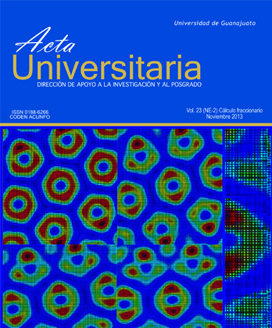
Vol. 23 (2013): (NE-2) Cálculo fraccionario
Artículos de investigación

Amplitude variation in fractional multiple-interference on N-beams

E. Alvarado Méndez Departamento de Electrónica, División de Ingenierías, Campus Irapuato-Salamanca, Universidad de Guanajuato. Carretera Salamanca-Valle Km 3.5 + 1.8, Comunidad Palo Blanco, Salamanca, Gto.
M. Trejo Durán Departamento de Electrónica, División de Ingenierías, Campus Irapuato-Salamanca, Universidad de Guanajuato. Carretera Salamanca-Valle Km 3.5 + 1.8, Comunidad Palo Blanco, Salamanca, Gto.
J. M. Estudillo Ayala Departamento de Electrónica, División de Ingenierías, Campus Irapuato-Salamanca, Universidad de Guanajuato. Carretera Salamanca-Valle Km 3.5 + 1.8, Comunidad Palo Blanco, Salamanca, Gto.
R. Rojas Laguna Departamento de Electrónica, División de Ingenierías, Campus Irapuato-Salamanca, Universidad de Guanajuato. Carretera Salamanca-Valle Km 3.5 + 1.8, Comunidad Palo Blanco, Salamanca, Gto.

Published 2013-12-01

Keywords

  • Array,
  • Array

How to Cite

Amplitude variation in fractional multiple-interference on N-beams. (2013). Acta Universitaria, 23, 36-39. https://doi.org/10.15174/au.2013.582

Abstract

Multiple periodic patterns by light interference are a complicated problem from an experimen­tal point of view. We report a theoretical model of the incidence of N beams of light at one point in space. Two components of the electric field are projected: azimuthal (angle formed with the projection of the vector in space on the x-y plane) and zenithal (angle of the incident vector with the z-axis). As a result, azimuthal intensity and zenithal intensity are found. The case of fractional amplitude or fractional number of beams is analyzed. When the phase is modified, the process allows us to visualize the change of geometry. Quasi-lineal patterns to maximum and minimum concentric circles are observed. Some applications of these patterns can be found in sensors and engraving in some lithography processes.

References